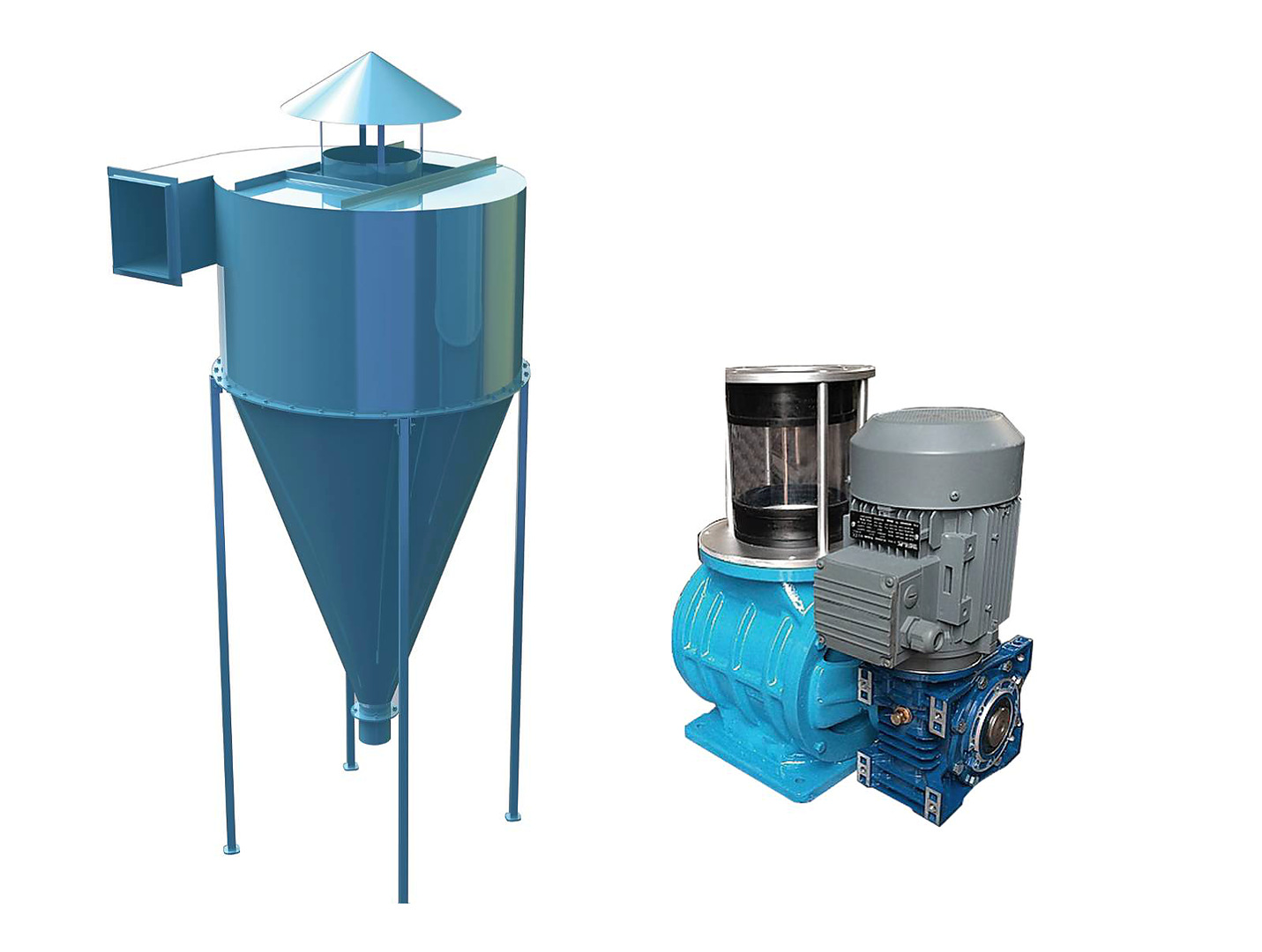
Cyclone & Airlock

Cyclone & Airlock TKS 1400–1800 / YRV 240–280
TKS-1400 / TKS-1800 · YRV-240 / YRV-300

Cyclone & Airlock

The cyclone separates air from solids by centrifugal force, while the airlock regulates product flow in pneumatic conveying systems.

Intended Use

A cyclone separates air and solid material in a mixture by centrifugal force. An airlock is an important component of pneumatic conveying systems. Airlocks control the discharge of granular, particulate, or powdered materials from silos, hoppers, cyclones, filters, mixers, and similar equipment. They prevent air from passing between the material inlet and discharge zones under pressure, vacuum, or gravity. The airlock ensures a steady, controlled product flow.


Technical Specifications

  • In addition to standard St37 steel designs, reinforced versions are available for heavy-duty applications.
  • The cyclones are optimally sized based on empirical measurements.
  • They have modular dimensions optimized for installation.
  • Installation time is minimized.
  • For abrasive materials, the cyclone separator can be reinforced with chromium steel or wear-resistant, high-Brinell-hardness plates.
  • Operation at high dust concentrations is possible.
  • Designed to separate and collect fine particles with optimal pressure losses.
  • Available with either right-hand or left-hand product inlets.
  • For capturing particles down to 50 microns in industrial dust collection systems, units are manufactured with airflow capacities from 1,500 m³/h to 90,000 m³/h.
  • Various drive options are available: direct coupling, flange-mounted geared motor, or coupling-connected geared motor.
  • They provide maximum separation in jet filters, cyclones, and cyclonettes.
  • The design also allows use with high-temperature materials.
  • The rotating assembly of the airlock is supported by bearings.
Need Industrial Solutions?
Contact Yaşar Makina